How to hire a plumber in Boston, MA
Plumbing is one of the few trades where small material and code decisions compound over decades. The more you understand about how pros scope a job, the better partner you can be — and the better the outcome.
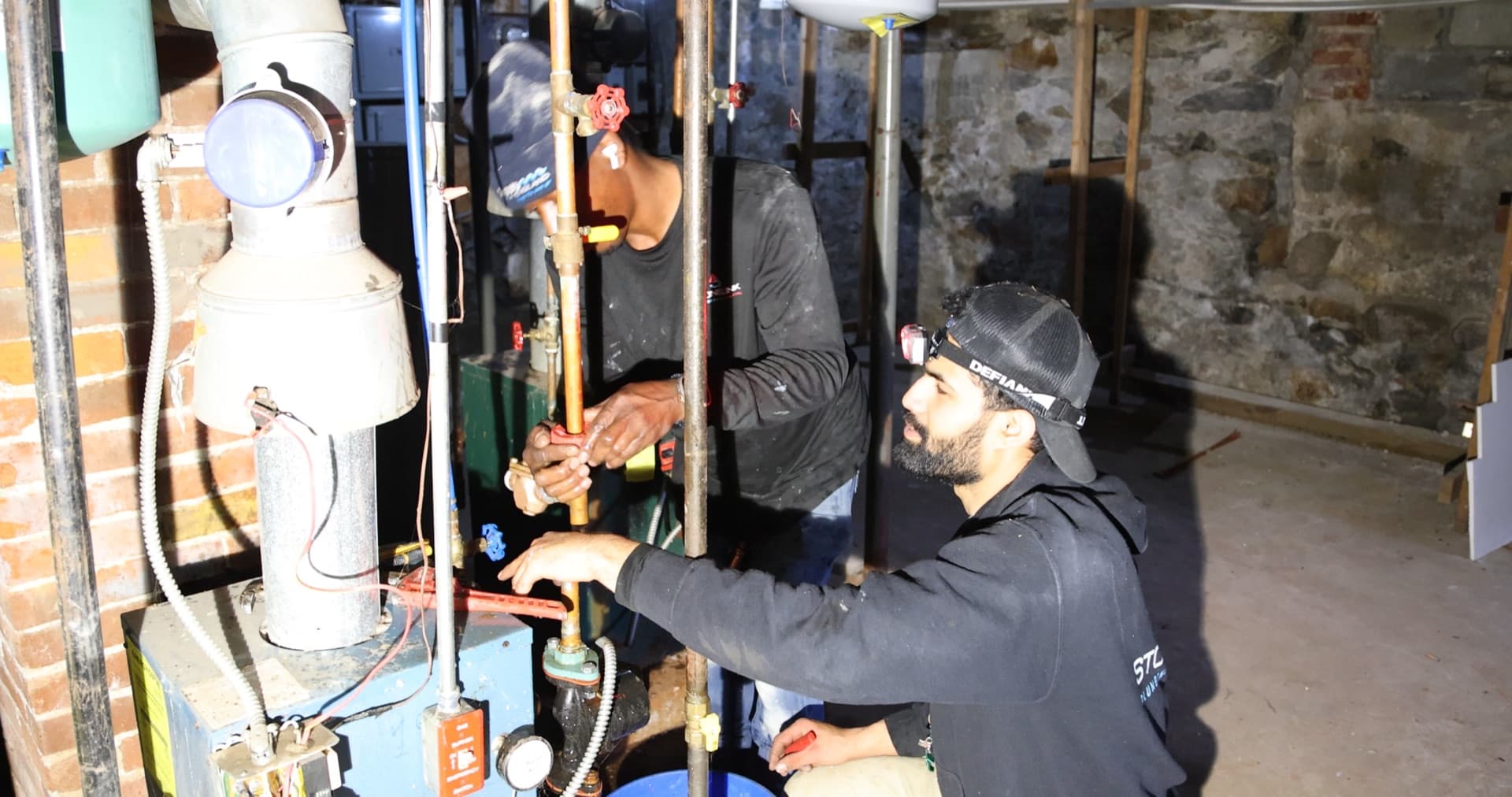
Stonelink Plumbing professionals at work
What to know before you call a plumber in Boston
Boston has some of the oldest housing stock in the country, including Beacon Hill brownstones, Back Bay row houses, South End bowfronts, and triple-deckers across Dorchester, Roxbury, and Jamaica Plain. Many properties are 100+ years old with lead paint, aging galvanized supply lines, knob-and-tube remnants, and historic preservation constraints.
Boston winters average ~49 inches of snowfall. Summer heat and humidity stress HVAC systems, and coastal storms, nor'easters, and bomb cyclones cause regular wind and water damage to exposed facades. Sea-level rise is making once-rare flood events routine in East Boston, the Seaport, and Charlestown.
How we price it
These are the factors that move a quote up or down. Knowing them helps you share the right context upfront so we can quote your specific situation accurately — and so you can compare bids on apples-to-apples scope.
Almost every replacement — water heater swap, repipe, drain line, new fixture rough-in — is permitted work under both the RI State Plumbing Code and 248 CMR (Massachusetts). A permit triggers an inspection, which means expansion tank, pressure-reducing valve, thermostatic mixing valve, and dielectric union are part of a complete install. Two bids can look very different on price because one includes these code-required parts and the other does not — worth comparing apples-to-apples.
For supply lines, PEX-A (Uponor/Wirsbo) installs 40–60% faster than copper because it bends around framing instead of needing elbows at every direction change. Copper still has a place in exposed mechanical rooms and pre-water-heater connections (high heat zones). For drains, schedule 40 PVC is the modern standard; ABS is allowed in some jurisdictions; cast iron is occasionally used in stacks for noise dampening in luxury builds. Replacing cast iron stacks with PVC is a major cost driver in any 1920s–1970s home.
The pipe is rarely the expensive part — getting to it is. A repipe in an open basement with an unfinished ceiling is straightforward. The same repipe in a finished colonial with plaster walls, tile bathrooms, and a slab on grade means drywall demo, tile cut-outs, and selective floor opening. Drywall repair and paint are not in the plumber's scope and are billed separately by another trade.
Swapping like-for-like is fast (toilet, kitchen faucet, hose bib). Moving the rough-in — a new vanity 18 inches over, a freestanding tub that needs a floor drain, a kitchen sink relocated to an island — is plumbing as construction: new supply, new waste, new vent, sometimes a new branch off the stack. Island sinks specifically require an air admittance valve (Studor) or a loop vent and trip up bids written from photos alone.
A like-for-like 40-gal gas tank swap with existing venting and gas line is a half-day, $1,400–2,400 job. Switching to tankless adds a 3/4" gas line upsize (often to the meter), new stainless venting, and 120V electrical for the unit — that is $3,500–6,500 installed. Heat pump water heaters are the long-game winner with the Mass Save $750 rebate (residential MA only) but need 700+ cu ft of ambient air, a condensate drain, and a 240V/30A circuit. Federal tax credits for heat pump WHs were repealed end of 2025; state rebates remain.
Most homeowners do not think about the lateral until it backs up. In southern New England, 1900s–1950s homes commonly have clay or Orangeburg (bituminized fiber) laterals that fail by collapse, not by clog. A camera inspection diagnoses this in 20 minutes. Trenchless pipe bursting beats open-trench replacement on most lots, but cast iron laterals add 30–50% to the burst cost because the existing pipe resists fracture.
After-hours and weekend calls bill at 1.5–2x to cover on-call staffing and the work the pro is leaving on the bench. A burst supply line at 11 PM Saturday is genuinely an emergency. But many "emergencies" — slow drain, dripping faucet, no hot water on Sunday morning — can wait until Monday and save a few hundred dollars on the same fix.
Project sizes we handle
Three scopes that cover almost everything in this trade. We'll help you place your project on the right tier based on the property, what you've already tried, and how long you plan to stay.
Diagnostic call, single-fixture or single-line repair, swap-out of existing equipment. Includes parts, labor, and a 30–90 day workmanship warranty on the specific repair. No code upgrades to the rest of the system.
- OEM replacement parts (Moen, Delta, Kohler cartridges)
- Brass shutoff valves over plastic 1/4-turn stops
- Sharkbite push-to-connect for emergency repairs only — not in-wall
- Wax ring + new flange bolts on every toilet reset
Best for: A specific, isolated problem on a system that is otherwise sound. Leaky faucet, running toilet, clogged drain, single-fixture rough-in.
Full equipment replacement (water heater, garbage disposal, toilet, faucet, washing machine valves) with code-required ancillaries — expansion tank, PRV, dielectric unions, thermostatic mixing valve where required. Permit pulled and inspected.
- Bradford White or AO Smith tank water heaters (US-made, contractor-grade)
- Watts or Caleffi expansion tank, PRV, and TMV (code-compliant brands)
- Insinkerator Evolution 3/4 HP or Waste King L-3300 for disposals
- Toto, Kohler, or American Standard chair-height toilets with 3" flush valves
Best for: End-of-life equipment, planned upgrades, or anything triggered by an inspection or insurance claim.
Repipe, new bath rough-in, sewer lateral replacement, or tankless conversion. Includes engineering for branch sizing, vent layout, and code review. Permit, inspection, and lien waiver from subs. Camera-verified on sewer work; pressure-tested on supply.
- Uponor PEX-A with ProPEX expansion fittings (best for slab or in-wall, no crimp failures)
- Type L copper for exposed runs and pre-water-heater connections
- Schedule 40 PVC for DWV, with no-hub or PVC for cast-iron transitions
- Rinnai or Navien condensing tankless with concentric stainless venting
- Rheem ProTerra heat pump water heater (Energy Star, Mass Save eligible)
Best for: Old homes (pre-1970), recurring leaks, capacity problems, or anyone done patching a failing system one leak at a time.
What we reach for and why
The materials and techniques behind a job that lasts — so you know what's in the quote and why it's there.
PEX-A (Uponor/Wirsbo) is manufactured by the Engel method and uses expansion fittings — you stretch the pipe with a tool, slide on the fitting, and the pipe shrinks back to lock the joint. It is more forgiving on tight bends and self-heals kinks with a heat gun. PEX-B is silane-cured, slightly stiffer, and uses crimp clamps or stainless press sleeves. Both meet NSF-61 for potable water. Copper Type L is still spec for exposed mechanical-room runs and the first 18 inches off a gas water heater.
Pull a hardened bursting head through the failed line via a winch, fragmenting the old pipe and dragging a new HDPE pipe in behind it. Requires two pits (one at the house, one at the city tap) instead of a continuous trench. Lawn, walkway, and driveway stay intact. Works on clay, PVC, and Orangeburg; works on cast iron with a heavier head and roughly 30–50% upcharge.
When a water heater heats cold water, the volume expands. If a check valve, backflow preventer, or pressure-reducing valve is between the heater and the street main (and there is one in nearly every modern install), that expansion has nowhere to go — pressure spikes, the T&P valve weeps, and the tank fatigues. The code fix is a 2-gallon expansion tank ($60–120 retail) installed on the cold inlet. PRV is required when street pressure exceeds 80 psi static, which is common in MA/RI muni water.
Modern code (and Legionella safety) wants tank temperature at 140°F to kill bacteria, but delivers fixture water at 120°F to prevent scalding. A TMV (ASSE 1017) installed at the tank blends in cold to drop delivery temp. Required in MA on most new heater installs; smart practice everywhere with kids or elderly occupants.
Heat pump water heaters extract heat from ambient basement air to heat water. 3–4x more efficient than electric resistance, work down to roughly 35°F ambient. They need 700+ cubic feet of unconditioned air around them, a condensate drain (it makes a few gallons of water per day), and a 240V/30A circuit. Mass Save pays $750 cash per unit on qualifying ENERGY STAR models in residential MA. The federal 25C credit (up to $2,000) was repealed for 2026 installs.
Cast iron is heavy, expensive, and quiet — water rushing down a cast iron stack is muffled by the mass. PVC is light, cheap, fast, and loud. In a 1920s home with a cracked stack, the question is not "cast iron or PVC" — it is "PVC with strapping and acoustic wrap, or do we live with the noise." Code accepts both; most renovators choose PVC for cost and timeline.
A push-camera (60–100 ft) on a flexible rod, with a video monitor and footage counter. Identifies cracks, root intrusion, offset joints, bellies, and pipe material in 20 minutes. Should be done before any spend over $500 on a drain line, and absolutely before buying any pre-1970 home.
What to watch for
A short list of the things that actually matter for safety, code, and your peace of mind. Worth confirming with any pro before you sign — we expect these questions and we're happy you ask.
What else might come up
Most projects touch more than one trade. Here's where this one usually overlaps with others — so you can plan ahead instead of scrambling.
Plumbing access cuts are typically left for a finish trade — plumbers focus on the pipework. A repipe in a finished house generally adds $1,500–6,000 of drywall, paint, and tile work on a separate invoice. Lining up that trade before the plumbing starts keeps the schedule tight.
Tankless heaters need 120V at the unit. Heat pump water heaters need a 240V/30A circuit. Disposals need a dedicated 15A switched circuit. The plumber will not run new wire — that is an electrician on a permit of their own.
Condensing tankless units share venting principles with high-efficiency furnaces — concentric PVC or stainless. If your boiler and water heater both vent the same chimney, switching to direct-vent tankless may strand the boiler's flue, requiring a liner ($1,500–3,500). HVAC sees the whole flue system.
A plumber will notch a joist within code limits; bigger structural changes (drilling a 4" hole through a beam for a drain) need engineering and carpentry sign-off. The GC sequences trades so the plumber is not the bottleneck on a remodel.
Trenching against the foundation or breaking the slab opens the question of waterproofing membrane, footing drain, and slab vapor barrier. Doing the plumbing first and the waterproofing later means re-excavating. Sequence them together.
What jobs typically cost
Fixed-rate pricing for our most common licensed plumber jobs. Materials included where noted. Hourly rate for everything else: $170/hr.
Faucet Replacement
Swap single or double-handle faucet
~1.5 hoursIncludes parts$400–$500Toilet Replacement
Remove old toilet, install new with wax ring
~2 hoursIncludes parts$650–$850Garbage Disposal
Under-sink disposal replacement or new install
~1.5 hoursIncludes parts$450–$650Water Heater (Tank)
Standard 40-50 gal tank swap, permit required
~4 hoursIncludes parts$1.9k–$2.5kDrain Cleaning (Snake)
Clear clogged drain line with mechanical snake
1 hour – 2 hoursLabor only$175–$350Pipe Repair (Accessible)
Fix exposed or accessible pipe section
1 hour – 3 hoursLabor only$175–$500
Whole-home repipes in PEX run $4–7 per linear foot installed; copper $8–12. Tankless gas water heater swaps $3,500–6,500 all-in. Service-call diagnostic visits are typically a flat $150–250 that gets credited toward the work if you proceed.
The big swings come from material (PEX vs copper, PVC vs cast iron), whether the existing rough-in is to code, and whether the job triggers a permit and inspection — most plumbing work does, and the inspection is part of why the bid is what it is.
What we show up with
The equipment we bring is part of what separates a real job from a shortcut. Here's what to expect on a typical visit.
Cold-pressed copper joints — no torch, no solder. Faster, leak-rate lower than soldered joints, lets you work near insulation and combustibles without a fire watch.
Stretches PEX-A pipe so an expansion fitting can be inserted; pipe shrinks back to grip the fitting. Required for PEX-A repipes; no crimping or clamping.
Diagnoses cracks, roots, bellies, and pipe material in sewer laterals and drain lines before any expensive work. Footage saved to USB for a second opinion.
Mechanical clearing of clogs in branch drains and lateral lines. Pro snakes have a power feed and interchangeable cutting heads for roots vs grease.
Clean square cuts on supply and waste — burred or angled cuts are the #1 cause of fitting leaks.
Basin wrench is the only practical tool for reaching faucet supply nuts under a sink. Channel-locks handle everything else from compression fittings to P-trap nuts.
Reads static and dynamic pressure at any outdoor spigot. $12 at any hardware store. Diagnoses PRV failure, water hammer, and low-pressure complaints in 30 seconds.
Find leaks behind walls, in crawlspaces, and under sinks. A moisture meter on drywall above a suspected leak is faster than cutting an exploratory hole.
How a job goes
Diagnostic visit & camera (if drain work)
Walk the property, find shut-offs, take a pressure reading, and identify pipe materials. For any drain or sewer scope, run a camera. Identify what is in scope, what is adjacent (electrical, drywall, HVAC), and whether the job needs a permit. 30–60 minutes for a typical residential issue.
What you see: The pro walking the basement and around the foundation with a flashlight, reading the water heater serial plate, asking about water pressure history and last major plumbing work.
Written scope & flat-rate quote
Itemized scope with brand-name materials (Uponor PEX, Bradford White heater, Watts PRV — not "code-grade fittings"), labor, permit fees, and any disposal or restoration line items. Discuss the quality tier and any code triggers the inspector will require.
What you see: A line-itemed PDF or printed quote with model numbers and a clear scope of "what we will do" and "what we will not" — drywall patching, paint, tile work usually called out as separate trades.
Permit pulled & materials staged
Permit application filed with the local building/plumbing inspector (1–3 days in most RI/MA municipalities). Materials ordered and staged. For larger jobs, a pre-job meeting with you to confirm shut-off plan and access.
What you see: A confirmed permit number you can look up on the municipality website, an install date, and (for repipes) a marked path of where the new pipe will run.
Install / repair
Shut-offs verified, demo as needed, new install per plan, pressure test on supply (60 psi for 15 minutes minimum), leak check on every joint. Sewer work gets pre- and post-camera footage. For water heaters: expansion tank, PRV, TMV, dielectric unions, sediment trap on gas line, drip pan with drain.
What you see: Quiet, methodical work — measure, cut, deburr, dry-fit, then connect. Pressure gauge attached for the test. Drop cloths on floors and stairs.
Inspection
Local plumbing inspector comes out — usually within 1 week of completion. They verify code compliance: pipe sizing, support spacing, vent terminations, expansion tank, PRV, TMV, dielectric unions, gas line pressure-tested with a manometer. They sign off the permit.
What you see: A municipal inspector (not your plumber) walking the install with a flashlight and a checklist. Signed inspection card or online portal update.
Walkthrough & documentation
Final walkthrough: shut-off locations, how to relight the pilot, how to flush the tankless or descale the anode, what the workmanship warranty covers. You get the closed permit, inspection sign-off, manufacturer paperwork, and a written warranty.
What you see: A binder or PDF packet with model numbers, serial numbers, warranty registration cards, the closed permit, and the inspector's sign-off. Not a verbal "you are all set."
- Photos of the fixture, water heater, or area in question (label, serial, age if known)
- Where the shut-off is and whether it works (whole-house and fixture-level)
- Age of the home and last known plumbing work (and whether it was permitted)
- Type of pipe you can see — copper, PEX, galvanized steel, cast iron, PVC
- Whether the issue is active (leaking now, no hot water, sewage backup) or planned (remodel, upgrade)
- Static water pressure if you have a gauge (laundry hose bib, $12 at any hardware store)
- Utility bills if you suspect a hidden leak (sudden 20%+ jump = supply leak)
- Whether your home has a basement, crawlspace, or slab on grade
- Septic vs municipal sewer; well vs municipal water
- Mass Save or RI energy program eligibility if considering a heat pump water heater
- Brown or rust-colored water at any tap (galvanized supply corrosion or water heater anode failure)
- Sewage smell in any drain even after running water (failed P-trap, dry vent, or cracked stack)
- Multiple drains gurgling or backing up at once (main sewer lateral blockage or collapse)
- Visible green/blue staining on copper joints (pinhole leak in progress)
- Active water on the floor near a water heater, no matter how small (T&P valve weeping or tank failing)
- Recent freeze with no water at one fixture (frozen and possibly burst pipe — shut off main now)
Permits, timing, and what's local to Boston
Permits & regulations
Boston's Inspectional Services Department oversees building, electrical, plumbing, and gas permits. The city has strict zoning, historic district overlays (Back Bay, Beacon Hill, South End, Bay Village, Mission Hill Triangle), state energy code plus the Boston stretch code, and BERDO emissions reporting for larger buildings.
Permit authority: Boston Inspectional Services Department (https://www.boston.gov/departments/inspectional-services)
What's local to Boston
Mass Save rebates (heat pumps, weatherization, induction) apply citywide and stack with BERDO compliance work — worth raising on any HVAC or envelope project.
What homeowners ask us
Other services we handle in Boston
Where else we serve
Ready to Get Started?
Call or text us for a free consultation about Plumber in Boston. Our experts are ready to help.
Call or Text
401.407.5678Available 7 days a week • Response within minutes
Get a Free Text Estimate: